


What if the fastest way to turn an idea into a product is to build less at first? A promising idea can feel exciting and still be too broad to guide a first release. Building before you know whether people have the problem can cost time and effort without giving you useful answers.
The better move is to reduce uncertainty one decision at a time. Define who has the problem and what they need to accomplish. Then test your assumptions, choose one core workflow for the first version, and put a usable product in front of early users. You don’t need a cut-down version of every feature you imagine. You need a reliable first release that solves one important problem well.
This roadmap takes you from problem definition to early feedback, with practical ways to validate demand and decide what belongs in your MVP. You’ll learn how to build toward real-world use, gather evidence from customers, and choose the next step based on what you learn rather than guesswork.
Key Takeaways
- Start with a specific user problem, then define the outcome your product should help someone achieve.
- Turn an idea into a product by writing a brief that makes your assumptions about users, value, and feasibility clear.
- Choose between a prototype, MVP, no-code approach, or custom build based on what you need to learn and what users need to experience.
- Keep the first build focused on one primary user and one core job, then test the smallest useful slice.
- Use real-world behavior and a few outcome-focused signals to decide what to refine or build next.
Turn an Idea Into a Product by Starting With a Real Problem
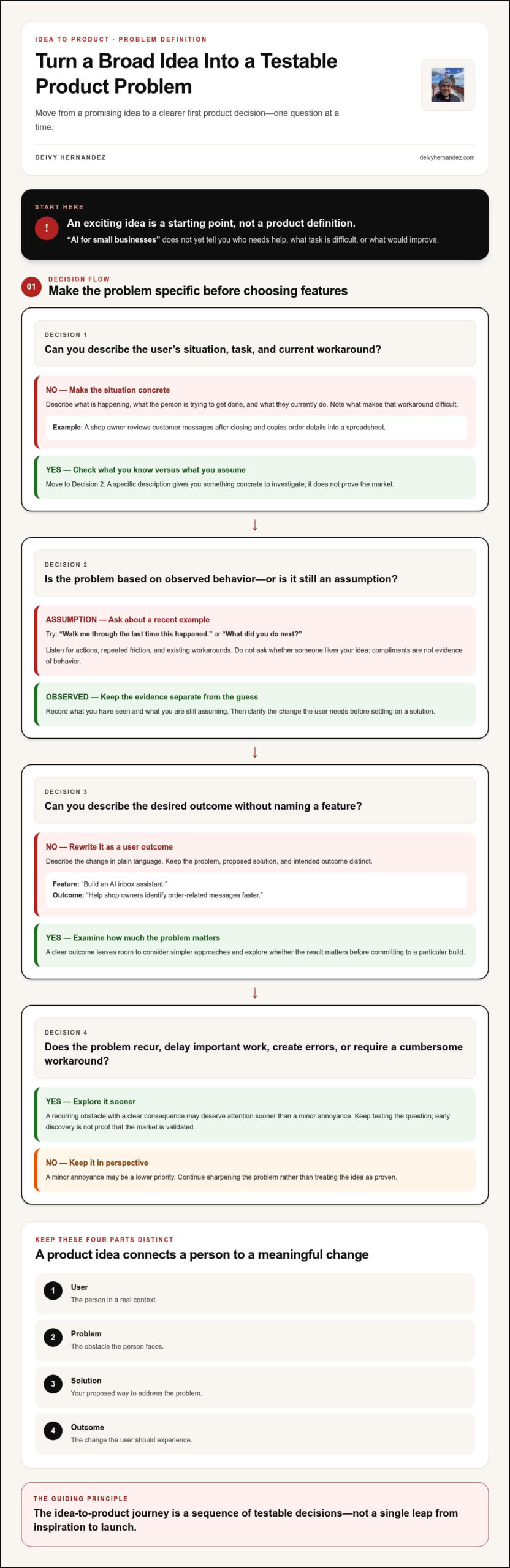
An exciting idea is a starting point, not a product definition. “AI for small businesses” might point toward an opportunity, but it doesn’t yet say who needs help, what task is difficult, or what would improve. To turn an idea into a product, make the problem specific before choosing features, tools, or technology.
A product idea is a proposed solution to a particular user problem. Keep four parts distinct: the user is the person in a real context; the problem is the obstacle they face; the solution is your proposed way to address it; and the outcome is the change the user should experience. For example, an independent shop owner might spend time manually sorting customer inquiries. A proposed tool could categorize them, while the desired outcome is less time spent organizing requests.
The idea-to-product journey is a sequence of testable decisions, not a single leap from inspiration to launch. Each decision should make the next step clearer.
Who has the problem, and when does it happen?
Describe a user through their situation, task, and current workaround. “A shop owner who reviews customer messages after closing and copies order details into a spreadsheet” gives you something concrete to investigate. “Busy business owners need AI” is too broad to guide product choices.
- Context: What is happening when the problem appears?
- Task: What is the person trying to get done?
- Workaround: What do they currently do, and what makes it difficult?
Separate what you’ve observed from what you’re assuming. A founder may believe people want automated replies, but conversations might reveal that finding urgent messages is the real pain. Ask about recent examples: “Walk me through the last time this happened” or “What did you do next?” Listen for actions, repeated friction, and existing workarounds. Don’t ask whether someone likes your idea. Compliments aren’t evidence of behavior.
What would a better outcome look like?
Describe the change in plain language before naming a feature or technology. “Help shop owners identify order-related messages faster” is an outcome to explore. “Build an AI inbox assistant” is a proposed solution. Keeping them separate lets you consider simpler approaches and test whether the result matters before committing to a particular build.
Then examine the problem’s weight. Does it recur as part of a regular task? Does it delay important work, create errors, or require a cumbersome workaround? A recurring obstacle with a clear consequence may deserve attention sooner than a minor annoyance. Early discovery is about sharpening the question, not declaring the market proven. For the next product decisions, the minimum viable product framework offers context on testing hypotheses and learning from early adopters. Keep detailed market sizing and broader validation methods for a dedicated validation guide.
Shape the Idea Into a Product Brief and Testable Assumptions
Once you’ve identified a problem worth exploring, capture the idea in a one-page brief. This gives the team a shared reference before design and development add complexity. A product brief connects a user problem to an outcome and testable assumptions. It should clarify what you’re trying to change, not lock you into a feature list.
Turn a product idea into a clear first brief
Keep the brief short enough to revise as you learn. Include the intended user and their context, the problem they face, the outcome they want, and your proposed solution. Write the problem without embedding the feature: “Claims reviewers spend time locating key details across submitted documents” describes a problem; “They need an AI document reader” already assumes a solution.
Map the intended journey from trigger to result. For example, a reviewer receives a claim, checks supporting documents, and needs to find the details required for a decision. Then define what evidence would support or challenge your approach. Would reviewers try a sample workflow? Can they complete the task more easily? Does the proposed solution fit into how they already work? You can use the SBA’s guidance on market research and competitive analysis to structure broader research into customer demand and alternatives.
Rank assumptions before you build
A brief makes hidden bets visible. Sort them into three groups: user behavior, product value, and technical feasibility. For each assumption, record what you believe, why it matters, and what observation could challenge it. Then prioritize by uncertainty and consequence. If you’re unsure whether users will share the necessary documents, and the whole workflow depends on that behavior, test it before investing in automation.
Use a simple priority rule: investigate assumptions that are both uncertain and damaging if wrong. A low-risk detail, such as a preferred button label, can wait. A core question, such as whether the input data is accessible at all, deserves an early test. This turns the brief into a decision tool, not a document that sits unchanged while the product moves in another direction.
Check feasibility without overengineering
Sketch the system’s real demands before choosing an architecture. Identify what data must enter, which integrations the workflow needs, what steps the user takes, and where a person must review or correct the result. For an AI concept, separate three questions: can a model perform the task on representative inputs, can the product deliver a dependable experience, and does the result help the user achieve the intended outcome? A promising model demo answers only part of that.
Keep technical discovery proportional to the decision at hand. You might test sample inputs manually or use a rough workflow to reveal missing data and review needs before building a full system. Detailed AI product development and technical discovery belong in focused follow-up guides. When an idea needs both product and AI expertise, AI and product-building project support can help turn its brief into practical next steps.
Choose the Right Path: Prototype, MVP, No-Code, or Custom Build
The right build approach depends on the uncertainty you need to resolve next. If you need to learn whether users understand a workflow, a prototype may be enough. If you need to see whether they get value from using it, build a focused MVP. A more technically ambitious approach won’t make an untested assumption safer. To turn an idea into a product, match the build to the question, then use what you learn to choose the next step.
The lean product development methodology centers on testing assumptions and learning from how people use what you build. Apply that principle here: select the lightest approach that can produce meaningful evidence.
| Approach | Purpose | What users can experience | Main tradeoff |
|---|---|---|---|
| Prototype | Explore an idea or workflow | Sketches, clickable screens, or a guided demonstration | Useful for reactions and comprehension, but doesn’t establish sustained use or operational reliability |
| Existing service | Test a workflow using available tools | A basic experience assembled from services already in use | Fast to explore, but may constrain the workflow or depend on manual work |
| No-code build | Test a working experience with limited custom development | A functional app or process with real interactions | Can accelerate learning, but platform limits may shape what’s possible |
| Custom build | Support requirements that need tailored software | A product designed around specific workflows and technical needs | Offers greater control, but requires more implementation decisions |
| MVP | Test a focused product value proposition | A coherent product experience that delivers its core value | Needs enough functionality to be useful without expanding into a full product |
When a prototype is enough to learn
Choose prototype fidelity based on the question. A sketch can show whether users understand a concept. A clickable flow can reveal where they hesitate or expect a different next step. A demonstration can help explore how a proposed feature might fit into an existing task. Keep the test narrow. A prototype can surface confusion, but it can’t prove people will return, that the system will work reliably, or that the workflow fits daily operations.
When an MVP or custom build makes sense
An MVP is the smallest coherent experience that delivers and tests the product’s core value. It isn’t a broken preview. Users should be able to complete the key task and reach the intended outcome. No-code tools or existing services may be enough to test a standard workflow. Consider custom development when essential integrations, unique processes, data needs, or technical constraints can’t be handled well with those approaches.
For AI products, test the complete user experience, not just whether a model can generate an output. Scoping should account for inputs, review, and what happens when results need correction. These decisions help determine whether a focused MVP can test the product’s promise.
Turn an Idea Into a Product With a Focused Build-and-Test Cycle
A clear product direction becomes real through a tight loop: define one user journey, build the smallest useful slice, test it with people, and refine it based on what happens. Keep the first release centered on one primary user and one core job. An early release should test a focused product promise, not a long feature list.
For example, imagine a scheduling tool meant to help a customer reschedule an appointment. The first journey might begin when the customer needs a new time, continue through choosing an available slot, and end with a clear confirmation. That’s the path to support. A calendar sync, team dashboard, and reminder preferences may be useful later, but they don’t belong in the first build unless the core journey depends on them.
Build the smallest coherent end-to-end experience
Map every essential step from the user’s trigger to the intended outcome. Mark what the product must do, what the user must provide, and where a handoff or decision occurs. Then remove anything that doesn’t help complete that first successful journey. The goal isn’t to make a tiny fragment. It’s to deliver one complete, useful experience without building the surrounding feature set prematurely.
For AI-enabled products, include reliability and oversight in the journey. Decide how the product handles incomplete inputs, uncertain outputs, and errors. Consider what information the feature needs and how it should be handled. If a consequential decision depends on generated output, define where a person reviews or corrects it. These are part of the product experience, not details to postpone until after launch.
Test with users and decide what changes
Give participants a realistic task and let them attempt it before you explain how the interface works. Watch where they pause, what they misunderstand, whether they finish, and what workaround they use. Ask them to describe what they expected at each step. Their behavior can reveal friction that a polite response or a feature request might miss.
After each session, sort observations into patterns. A repeated struggle to find the next step may point to a flow problem. One person asking for a particular color or shortcut may be a preference, not a priority. Feature requests are clues, but first identify the need behind them. Then choose a response: fix a confusing step, narrow the promise to what works, or revisit the product hypothesis if users don’t value the outcome.
- Define: Write down the user, core job, and successful outcome.
- Build: Create only what’s needed to complete that journey.
- Observe: Watch real attempts and record friction without steering users.
- Refine: Address recurring issues, then test the updated experience.
This cycle turns an idea into a product through evidence gathered in use, not scope added by instinct. Deivy Hernandez’s AI and product-building project support focuses on moving product concepts toward practical next steps. Explore the project support.
Launch, Learn, and Decide What to Build Next
A launch puts your product into real use. It doesn’t prove product-market fit or mean the roadmap is settled. It gives you a chance to see whether people can complete the intended task, where they struggle, and what happens outside a controlled test. To turn an idea into a product people keep using, treat an early release as a learning point, not a finish line.
Set learning goals for an early release
Before release, decide what you need to learn. Can users reach the intended outcome? Where do they stop? Do they return to repeat the core task? These questions help you choose a small set of signals tied to the product’s purpose rather than collecting activity for its own sake.
Useful signals might include:
- Task completion: Do users finish the journey that delivers the intended outcome?
- Drop-off points: Where do users leave or need help?
- Repeat behavior: Do people return when the same need arises again?
- Operational issues: How often does the team need to correct errors or step in?
Downloads, sign-ups, and page views can show that people noticed the product. By themselves, they don’t show that users received lasting value. Pair activity measures with evidence of task completion and user feedback. For an AI product, look at whether outputs help people move forward, how often they require correction, and whether review steps create unexpected friction. Interpret the signals together. A user who stops may have lost interest, encountered a blocker, or simply had no reason to continue yet.
Choose the next move: improve, expand, or rethink
Use patterns in user behavior, feedback, and operational issues to choose what to do next. If people want the outcome but repeatedly struggle with the same step, improve the core journey. If they complete it and describe another related need, investigate that need before expanding scope. If users don’t reach or value the promised outcome, reconsider the product assumption instead of adding features around it.
Keep the decision tied to evidence. One request can suggest a question to explore, but repeated behavior or friction gives you a stronger reason to act. Operational problems matter too: recurring manual fixes may reveal that the workflow, data handling, or AI output needs attention before more users rely on it. Record what you observed, what you changed, and what the next release should help you learn.
That’s how shipping becomes a cycle: release, observe, decide, and improve. Deivy Hernandez has been building and shipping products since 2015, including products that use AI and machine-learning technologies. If you have a relevant product opportunity, start a conversation about your product idea.
Make Your Next Product Decision Count
The next step doesn’t have to be a major commitment. Choose one unresolved question that could change your direction, then design a small way to learn more. A short user conversation, a rough workflow, or a focused technical experiment can help replace guesswork with evidence. The point isn’t to eliminate uncertainty before you act. It’s to make each move teach you something useful.
That mindset makes it easier to turn an idea into a product without treating your first plan as permanent. Let the evidence shape what you build, what you leave out, and where you invest attention next. Progress comes from decisions that bring you closer to a real user outcome.
If you have a product opportunity you’re ready to explore, let’s talk about building it. A clear next step can turn early momentum into meaningful progress.
Frequently Asked Questions
How do I turn an idea into a product if I have no technical background?
You can lead the product work without writing code. Start by documenting a real user scenario, collecting examples of the current process, and deciding what a useful result would look like. A simple screen mockup or written workflow can help explain the idea to a technical collaborator. Your role is to keep the user need and product decisions clear, then work with builders to turn those decisions into something people can use.
How long does it take to turn an idea into a product?
There’s no fixed timeline. It depends on how clearly you can define the first user experience, how many systems it needs to work with, and how much testing or review the product requires. A clickable demonstration can be assembled much sooner than a dependable product that handles real users and data. Plan around learning milestones, such as testing a workflow or completing a release, rather than assuming a calendar estimate before the scope is understood.
Do I need to protect my idea before discussing it with potential users?
Usually, you can discuss the problem and the result you hope to create without revealing every implementation detail. Focus early conversations on how people handle the task today and what makes it difficult. Keep dated notes of your product decisions and avoid sharing sensitive technical details unnecessarily. The right protection depends on what you’ve created and where you operate, so don’t assume that an idea alone receives the same protection as a specific invention or creative work.
How much does it cost to turn an idea into a product?
There isn’t one reliable price for every product. Cost depends on the scope, integrations, data requirements, design, testing, and ongoing work needed to operate it. A prototype and a production-ready product are different commitments, even if both demonstrate the same concept. Before setting a budget, define the first user outcome and list what the release must support. Then compare the effort of building that focused experience with the value of what you need to learn.
Can I turn an idea into a product without a cofounder?
Yes. A cofounder isn’t a prerequisite, but you’ll still need access to the skills and perspective the product requires. You might lead customer and business decisions while bringing in technical expertise for specific build work, or collaborate with a product-minded builder. Be clear about ownership, decision-making, and responsibilities from the outset. The important question isn’t whether you have a cofounder, but whether the work has capable owners and the product stays close to user needs.
What should I do if users do not respond to my first product version?
First, check whether the right people saw it and understood what it was for. Silence can mean the audience was hard to reach, the value wasn’t clear, or the product didn’t fit a current priority. Follow up with a small number of intended users and ask what they did when the need last came up. If the problem matters but your approach doesn’t fit, adjust the offer or workflow before adding features.
Can AI help me turn an idea into a product?
Yes, AI can support tasks such as organizing research notes, drafting interface copy, generating early code, or exploring a workflow. Treat its output as a starting point, not proof that the product is useful or ready to ship. Check generated work for accuracy, security, and fit with the actual user task. For an AI-based product, also consider what happens when inputs are unusual or outputs are wrong, and design a sensible way to review or correct them.
1 comment