


What if the hardest part of AI product development isn’t choosing a model, but finding a problem worth solving? AI can make almost any idea sound possible. That doesn’t mean it belongs in the product. A prototype may impress in a demo, then stumble when real users bring messy inputs, expect consistent results, and need the feature to fit their everyday workflow.
If you’re weighing an AI opportunity, start by making the uncertainty specific. What task is difficult today? Where does the current process break down? What would a useful result look like, and how would you know the feature helped? Those answers shape decisions about the AI approach, product experience, testing, and ongoing operations.
This guide breaks down the stages of AI product development, from defining the problem and choosing an approach to evaluating reliability, cost, risk, and workflow fit. You’ll see how to move from a promising prototype toward real-world use, and how to choose a practical next step. The goal isn’t to add AI for its own sake. It’s to shape the technology around a real need and build something people can use.
Key Takeaways
- Learn how an AI-powered product differs from conventional software built with AI tools.
- See how user needs, product experience, data, models, and software decisions connect across AI product development.
- Compare AI and rule-based systems to understand where model-driven behavior fits and what it changes.
- Use a practical checklist to scope AI behavior, evaluate quality, and plan for ongoing operations.
- Define success around user tasks, then choose a focused next step to move an opportunity forward.
What AI product development means, and what it does not
AI product development means building a product where AI behavior is part of the user experience. A model might interpret a request, generate a response, classify information, or recommend an action. Its output affects what the user sees and what they can do next. That makes the model one part of a wider system, alongside the interface, data, software rules, and safeguards.
AI product development is the work of shaping AI behavior into a useful, dependable product experience that solves a real user problem. The technology is a means to an outcome, not a product strategy on its own. Start with the user’s task, then compare an AI approach with a simpler one. If a clear rule or conventional software flow can do the job, a model may add complexity without improving the experience.
AI in product development versus AI product development
The phrases can describe different things. A team might use an AI assistant to summarize research or draft product copy while building an ordinary scheduling app. That’s AI supporting product development. If the app uses a model to interpret a user’s scheduling request and suggest a workable time, AI is part of the product itself. The two uses can overlap, but they raise different design and engineering questions.
This article focuses on building useful AI-enabled products, from framing the problem to supporting real use. The key question isn’t simply whether a team can add AI. It’s whether the feature helps users complete a meaningful task, and whether the product can handle the range of inputs and outcomes users will encounter.
What makes an AI-enabled product different?
In conventional software, a rule often maps a known input to a defined result. A model can produce different responses to similar requests, misunderstand context, or return an answer that sounds confident but isn’t useful. That variability becomes a product concern when users rely on the output. Decide what the model may do, where it needs limits, and when a person or predictable software rule should take over.
The model is only one part of the system. Data quality and access affect what it can use. The user workflow determines what information is available and how the result fits into the task. The surrounding software handles validation, error states, and escalation when the AI can’t respond appropriately. Practices such as machine learning operations (MLOps) connect model development with the work of deploying and maintaining models in production.
That doesn’t mean every product needs AI. Treat fit as a decision to test, not an assumption to build around. Identify the task, the user’s current workaround, and the outcome that would improve the experience. Then compare AI with simpler options. The strongest product choice is the one that serves the user reliably, whether it uses a model or not.
How AI product development moves from user need to a working system
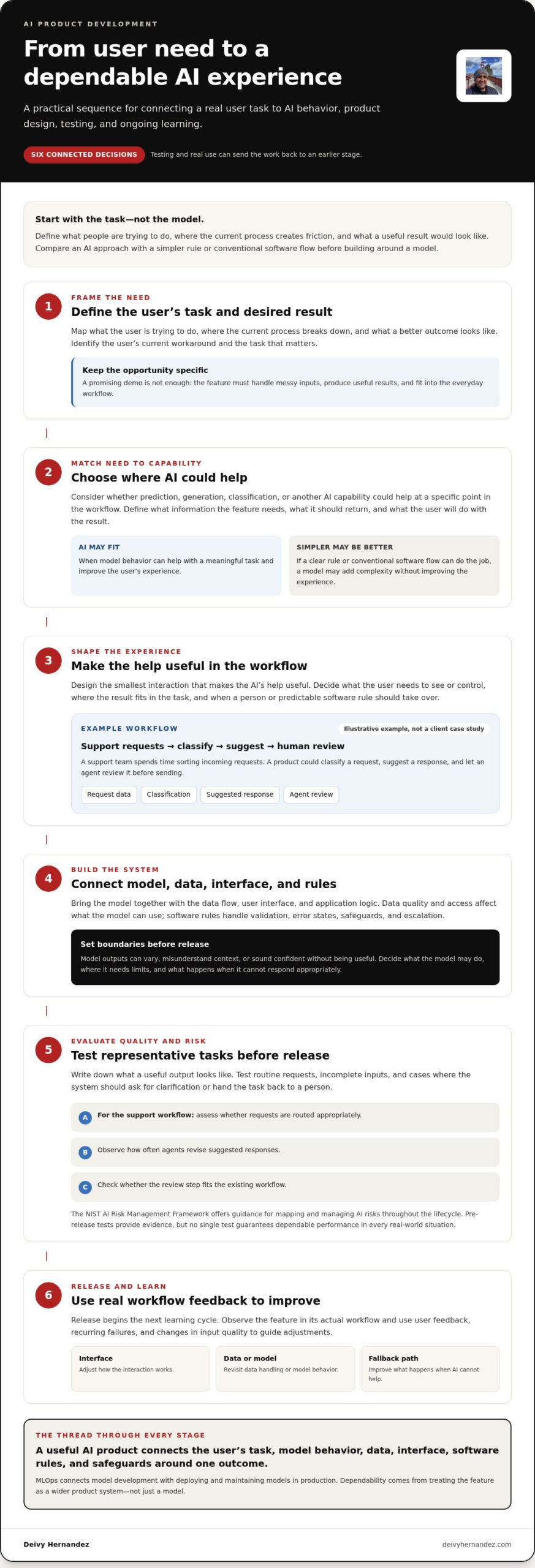
A dependable product starts with a task people need to complete, not a model someone wants to try. From there, connect product decisions to model behavior, data access, interface design, and the software that holds the experience together. This sequence gives the work direction, but it isn’t one-way. Testing and real use may show that the problem needs reframing or that the design should change.
Connect the customer workflow to an AI capability
Map what the user is trying to do, where the current process creates friction, and what a better outcome looks like. Then consider whether prediction, generation, classification, or another AI capability could help at a specific point. Define the information the feature needs, what it should return, and what the user does with that result. Design the smallest interaction that makes the help useful. Don’t choose a model first and search for a problem it might solve.
Example workflow, not a client case study: A customer support team spends time sorting incoming requests. A product might classify a request, suggest a response, and let a support agent review it before sending. The team can evaluate whether requests are routed appropriately, how often agents revise suggestions, and whether the review step fits the existing workflow. Classification, request data, the interface, and application logic all support the same outcome: handling requests more effectively.
Build, evaluate, release, and learn
Once the interaction is clear, bring the model together with the interface, data flow, and application logic. Write down what a useful output looks like and what should happen when the system can’t provide one. Before release, test representative tasks, including routine requests, incomplete inputs, and cases where the system should ask for clarification or hand the task back to a person. The NIST AI Risk Management Framework offers guidance for mapping and managing AI risks throughout this lifecycle.
Release starts the next learning cycle, not the end of the work. Observe the feature in its actual workflow. User feedback, recurring failures, and changes in input quality may point to adjustments in the interface, data handling, model behavior, or fallback path. Pre-release tests provide evidence, but no single test guarantees dependable performance in every real-world situation.
From product problem to AI-enabled experience
Think of the lifecycle as six connected decisions:
- Frame the need: Define the user’s task, friction, and desired result.
- Shape the experience: Decide where AI helps and what the user needs to see or control.
- Build the system: Connect the model, data, interface, and application rules.
- Evaluate: Test outputs against representative tasks and product expectations.
- Release: Put the feature into the workflow with appropriate boundaries and fallback behavior.
- Learn: Use observed performance and user feedback to guide the next iteration.
Not every part needs AI. Predictable software can manage permissions, route work, validate required fields, or request human review. Use the model for the part that benefits from interpretation or generation. Keep early validation focused on whether the problem and interaction make sense. For example, test whether users can complete the task with the proposed feature before spending time refining model behavior.
That’s the practical rhythm of AI product development: connect a real task to a useful capability, then improve the whole system as evidence emerges. For a founder-led perspective grounded in building and shipping products since 2015, explore Deivy’s work on building and shipping products.
AI product development versus conventional software: what changes?
Conventional software usually follows rules the team defines. Given the same inputs and conditions, it can return the same result. AI-enabled software adds behavior that depends on a model, which may interpret patterns or language but can produce different outputs for similar inputs. That changes how you design the experience, prepare data, and judge whether the feature is working.
Model-driven behavior adds product value when it handles meaningful patterns or ambiguity that fixed rules cannot address simply, and its output can be evaluated within the user’s task. AI doesn’t need to replace the whole system. A product can use predictable code for permissions, calculations, and workflow steps, while a model handles a bounded task such as grouping open-ended customer feedback by theme.
| Consideration | Rule-based software | Model-dependent behavior |
|---|---|---|
| Best suited to | Defined processes with clear conditions and expected outcomes. | Tasks involving patterns, language, or inputs that vary in form. |
| Data needs | Structured inputs and explicit rules can be enough. | Useful, representative data helps produce relevant outputs; poor or incomplete data can limit results. |
| Output consistency | Same conditions generally follow the same programmed path. | Responses can vary, even across similar requests. |
| Evaluation | Check whether rules return the expected result for defined cases. | Test quality across varied examples and assess whether outputs support the intended user task. |
| Ongoing operations | Maintain code and update rules as requirements change. | Also monitor output quality, latency, data changes, and inference expense. |
When a model adds value, and when it adds friction
Consider a team reviewing open-ended product comments. Fixed rules can find known words, but may miss different phrasing that expresses the same concern. A model could help surface recurring themes for review. By contrast, applying a fixed discount or checking whether a required field is present calls for a predictable rule. A model there may add uncertainty without improving the task.
User expectations matter. If people need an exact, repeatable answer, output variation can erode trust or create costly mistakes. If the task is exploratory, a useful suggestion with clear review may be acceptable. Match the model’s level of independence to the consequence of being wrong.
Tradeoffs founders should make visible
Before choosing an approach, make the tradeoffs explicit. What input data does the feature rely on, and is that data usable? How quickly must it respond? What inference expense will repeated use create? How will the product handle an irrelevant or inconsistent answer? Turn the answers into product requirements, such as an acceptable response time, a review step, or a fallback route. AI doesn’t automatically reduce cost or speed up delivery; it can add evaluation and operational work alongside the capability it provides.
For many products, the practical choice isn’t AI or conventional software. It’s deciding which parts benefit from model behavior and which should remain deterministic. That boundary keeps the experience focused and gives users more predictable paths where consistency matters most.
How to make AI product development practical and dependable
Dependability starts with a clear definition of success. Before choosing metrics or tuning a model, name the user’s task and the result that would make it easier, faster, or more effective. If the feature helps people draft replies, for example, assess whether they can produce a useful response with less correction, not whether the model’s answer sounds impressive in isolation.
Set useful product and AI evaluation criteria
Model performance describes how well a model handles a task; product success describes whether people can use the whole feature to complete that task. Both matter, but they answer different questions. A model can produce relevant text while the interface hides important context or makes the answer difficult to review. Test the complete product experience, not only the model output.
Build an evaluation set around representative user tasks. Include routine cases, unusual inputs, and examples where the system should admit uncertainty, ask for clarification, or hand the task back to a person. For each example, define what an acceptable result looks like and how a reviewer will judge it. Pair model-level checks, such as relevance or correct classification, with user-facing measures such as task completion, time spent correcting output, and whether users accept or discard suggestions. Keep the core question in view: does this help users do the job?
Plan for uncertainty, oversight, and learning
Make the feature’s limits clear. Users should know when an answer is a suggestion, what information it relies on, and how to correct it. For higher-impact tasks, provide a review step before an AI-generated result triggers an important action. A non-AI fallback, such as a manual route or a clear request for more information, can keep the workflow moving when the system can’t help.
- Scope the behavior: Define what the feature should do, what it must not do, and when it should stop or escalate.
- Check the data: Identify what information the feature needs, who can access it, and whether it should be stored or passed to another system.
- Test the experience: Try representative tasks, edge cases, and failure states. Record where users need to intervene.
- Plan operations: Decide how the team will monitor quality, latency, usage, and inference expense after release.
- Set ownership: Make clear who reviews issues and how the team will respond when behavior changes or users report a problem.
Monitoring should match the product’s risk and role. A low-stakes drafting aid may need different oversight from a feature that informs consequential decisions. In either case, release is the start of a feedback loop: review actual use, look for recurring failures, and update the system or workflow when evidence points to a better approach. Treat validation, risk management, and post-launch iteration as connected workstreams rather than one-time checks.
Practical AI product development keeps the user outcome at the center while making uncertainty, access, and failure paths visible. Deivy Hernandez provides project-based AI and product-building support for opportunities aligned with his experience. Learn about working with Deivy on your product project.
Turn an AI product opportunity into real-world progress
You don’t need every technical decision settled before taking a useful next step. You do need a clear picture of the problem, a reason AI might help, and a way to learn whether the product idea fits the real task. Use this sequence to make the next decision concrete:
- Clarify the problem. Describe who has the problem, what they’re trying to do, and where the current experience falls short.
- Test the product logic. Explain how an AI-supported interaction could improve the task and what the user should be able to do with its output.
- Choose a next action. Identify what evidence, conversation, or focused experiment would help you make the next decision.
This isn’t a commitment to build a full product immediately. It’s a way to turn a broad AI possibility into a product opportunity you can examine and move forward with purpose. If the user, task, or role of AI is still unclear, work on that definition first. If those elements are coming into focus, choose the next step that will test the product logic. For a broader roadmap from problem definition to early feedback, see how to turn an idea into a product.
When hands-on AI product-building experience can help
Early product work often means connecting technical choices to real user needs before the path is obvious. A founder may have a promising opportunity but still need to think through how AI or machine learning fits the experience, what the system needs to do, and how to move toward a product people can use.
Deivy Hernandez is an entrepreneur and technical founder focused on building AI and machine-learning products that solve real-world problems. He has been building and shipping since 2015. His experience spans taking products from zero to one and scaling them, bringing a hands-on builder’s perspective to product and technical decisions.
Start with the product opportunity
A useful first conversation can begin with three points: who the user is, what problem they face, and why AI may be relevant to solving it. You don’t need a polished pitch. A concrete description of the task and current friction gives the opportunity a practical starting point. From there, focus on the product problem and the decisions that could move it closer to real-world use.
For founders with an aligned project or opportunity, start a conversation with Deivy about the user need you’re exploring and where you see AI fitting into the product.
Make the next product decision count
The next move doesn’t have to be a full build. Choose one uncertainty that matters: whether the user problem is urgent, whether AI can improve the task, or whether the proposed experience makes sense in the workflow. Then take a focused step to learn more. A clear question can turn a broad idea into forward motion.
That’s the practical mindset behind AI product development. Treat each decision as a chance to connect technology to a real need, not as pressure to add more features or chase the newest model. A product becomes more grounded as you learn what users need and what the experience must do to help them.
If you’re working through an AI product opportunity, Deivy brings a founder’s perspective to building products from an early idea toward real-world use. Share the user problem and the decision you’re trying to make. Discuss your product opportunity with Deivy.
Frequently Asked Questions
When should a product use AI instead of conventional software?
Use AI when a task depends on interpreting language, recognizing patterns, or responding to inputs that don’t fit neatly into predefined rules. For example, AI might help organize free-form product search requests, while conventional code should handle an exact invoice total. Let the customer outcome guide the choice, not novelty. Products can combine both approaches, and if a simpler workflow solves the task well, it may be the better option.
Does AI product development always require training a custom model?
No. A product team might use an existing model, adapt one for a particular task, or train a model, depending on the product’s requirements and constraints. Consider the behavior users need, the data involved, the level of control required, and the operating environment. For example, a feature that summarizes internal records may have different requirements from one that classifies specialized images. Choose an approach based on those needs, not a universal rule.
What data does an AI product need?
It depends on the feature and the model approach. Some data may be used to build or adapt a model; other information may be processed only when someone uses the product. A product that classifies public text, for instance, has different data needs from one that works with a user’s private records. Define the data’s purpose, permissions, quality, and handling before collecting it. Not every AI product needs a large proprietary dataset or sensitive information.
How do you measure whether an AI product is working?
Start with the user’s task and define what a useful result looks like in that context. Then test model behavior on examples that reflect actual inputs, including cases where the product should return an uncertain result. Track product measures too, such as whether users complete the task, how much they need to correct, or whether they return to the feature. AI product development needs measures suited to the product’s purpose and risk, not one universal benchmark.
Can a small startup build an AI product without a large engineering team?
It can, but the work depends on product scope, complexity, integrations, and ongoing operational needs. Keep the first version focused on one user problem and a narrow experience rather than building a broad feature set. A small team still needs a way to evaluate output, handle data appropriately, and decide what happens when AI gives a weak response or becomes unavailable. A focused scope helps the team learn before taking on more complexity.
What happens when an AI feature gives a wrong or incomplete answer?
Plan for imperfect outputs and give users a clear way to respond, such as correcting the result, requesting clarification, or switching to a non-AI path. The right design depends on the task and the consequences of an error. For a low-impact suggestion, user correction may be enough. For a higher-impact decision, add an appropriate human review step. Review can help catch issues, but it doesn’t guarantee that every answer will be correct.
How is an AI product maintained after launch?
Teams maintain an AI product by observing how it performs in use, reviewing user feedback, and checking quality measures that matter to the feature. Changes in user behavior, input data, or model behavior can create new failure patterns or reduce usefulness. Investigate those signals and improve the product where needed. Ongoing evaluation is part of product ownership, but the right monitoring methods and review rhythm depend on the feature and its role.
1 comment